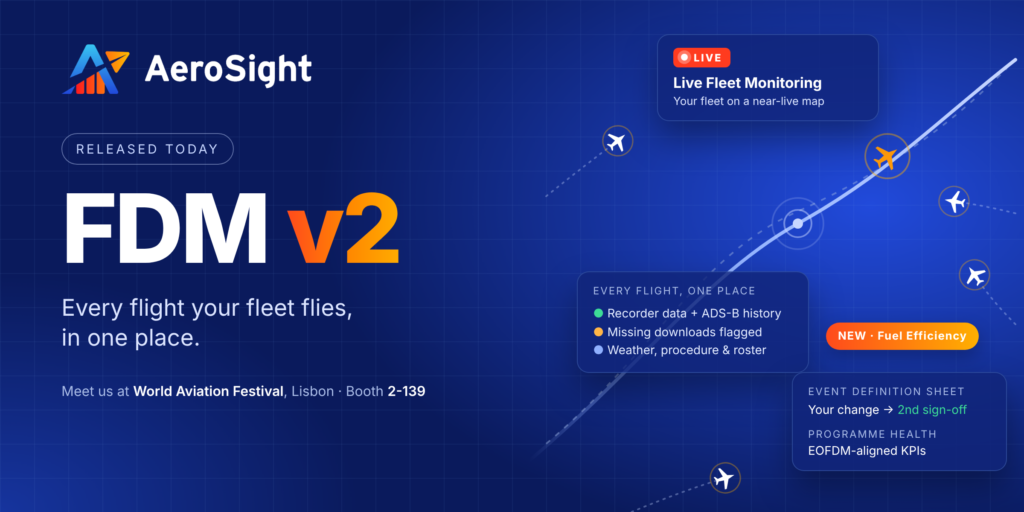
BAIA member AeroSight marks ten years of flight data monitoring with a rebuilt platform, released on 5 October 2026.
In 2016 a small team in Sofia set out to make flight data monitoring something an operator could rely on every day, not only at audit time. Ten years on, AeroSight has supported flight data monitoring programmes for 100+ operators across 40+ aircraft types. It processes 40,000 flights a month, and more than 1.5 million since 2016. On 5 October the company released AeroSight FDM v2, a rebuild of the platform around what those ten years taught.
Flight data monitoring (FDM) is the routine, non-punitive use of the data recorded on every flight to find risk before it turns into an incident. In Europe it is required for commercial operators of aeroplanes above 27 tonnes under ORO.AOC.130, and many smaller operators run a programme voluntarily.
AeroSight FDM v2 is built around one idea: the programme should ask for a person’s time only when their judgement is needed, and keep a record of what they decided.
- – Every flight the fleet flies. ADS-B flight history sits beside the recorder data, so a flight that was flown but never uploaded is flagged rather than missed, and Live Fleet Monitoring puts the fleet on a near-live map.
- – All in one platform. METAR weather, AIRAC procedures and, where a crew planning system is connected, the crew roster are linked to every flight and every event.
- – Detection tuned by the operator. The operator changes its own Event Definition Sheet (EDS); every change is signed off by a second person before it takes effect, and every revision is kept.
- – Programme-health KPIs aligned with the EASA EOFDM guidance, reports the operator builds itself, and an audit trail of every governance action.
- – Fuel Efficiency, a new module, alongside engine condition monitoring and Pilot Performance, rebuilt so each operator can tailor them.
The timing matters for European operators. EASA’s revised acceptable means of compliance for FDM programmes, ED Decision 2025/020/R, applies from 1 January 2028 and sets out in more detail what a programme is expected to do. Operators have until the end of 2027 to adapt.
“Ten years ago we started AeroSight so that flight data monitoring would work for the operator, not the other way round,” said Milko Lorinkov, CEO of AeroSight. “v2 is what ten years of running programmes taught us: the only work you should have to do is the work that needs a person.”
The timing matters for European operators. EASA’s revised acceptable means of compliance for FDM programmes, ED Decision 2025/020/R, applies from 1 January 2028 and sets out in more detail what a programme is expected to do. Operators have until the end of 2027 to adapt.
The launch film, “10 years of AeroSight: introducing AeroSight FDM v2”, is at aero-sight.com/v2. AeroSight will show v2 at the World Aviation Festival in Lisbon, 13–15 October, at booth 2-139.
Members who would like to see AeroSight FDM v2 on their own data can request a demo at aero-sight.com/request-a-demo.
Contact: sales@aero-sight.com , +359 889 308 615